
Sherlock Holmes was talking about detective work. Sales teams could steal the rule.
Your prospecting platform tells you a company has hired three SDRs, appointed a new VP Sales and announced a funding round. The account lights up. The score goes up. Someone says, “Get them into a sequence.”
The data may be completely accurate. The theory built around it may still be fiction.
The new VP might have been hired to improve retention rather than outbound. Those SDR roles could be replacements. The funding might be going almost entirely into product development. Yet somewhere between signal detected and message generated, possibilities start getting written as facts.
That is the problem with B2B buying signals. They are incredibly useful when they tell you where to look. They become dangerous when they pretend to tell you what the buyer is thinking.
The goal is not to become better at spotting signals. It is to become better at knowing what each signal earns you the right to do next.
“A signal can earn your attention without earning your conclusion.
”
What are B2B buying signals?#
B2B buying signals are observable behaviours, events or changes that may indicate an account deserves greater sales attention or is moving closer to a commercial decision.
The important word is may.
A demo request is a buying signal. Repeated engagement with decision-stage content can be a buying signal. So can a leadership appointment, relevant hiring, expansion, funding, technology change or increased category research.
But those events contain very different amounts of information.
Someone asking for pricing has told you something about their commercial interest. Someone hiring a new CRO has told you something about their organisation.
Both matter. They should not produce the same sales response.
Stop asking whether the signal is “strong”#
A better question is:
How far is this signal from an actual buying decision?
Think about two examples.
A prospect asks whether your product works with their CRM and what implementation involves. There are very few assumptions between that behaviour and the possibility of an evaluation.
Now imagine a company has raised £10 million.
To get from funding announced to they need the thing we sell, your brain has to cross several bridges:
They raised money → they will invest in growth → growth will affect our area → their current approach will become inadequate → they will consider a solution → ours will be relevant.
That does not make funding useless.
It makes it a research trigger, not a buying conclusion.
This gives sales teams a much more practical model for interpreting B2B buying intent.
| Level | What happened | What should sales do? |
|---|---|---|
| Act now | The buyer has shown direct or strongly supported commercial interest | Respond while the context is current |
| Look closer | Something meaningful has changed around the account | Research before choosing the angle |
| Context | The information improves your understanding but does not change urgency | Use it only if it makes the conversation better |
| Ignore | The signal is weak, stale or unrelated to your proposition | Do not let it influence outreach |
The point is not to create another score.
It is to decide the next action.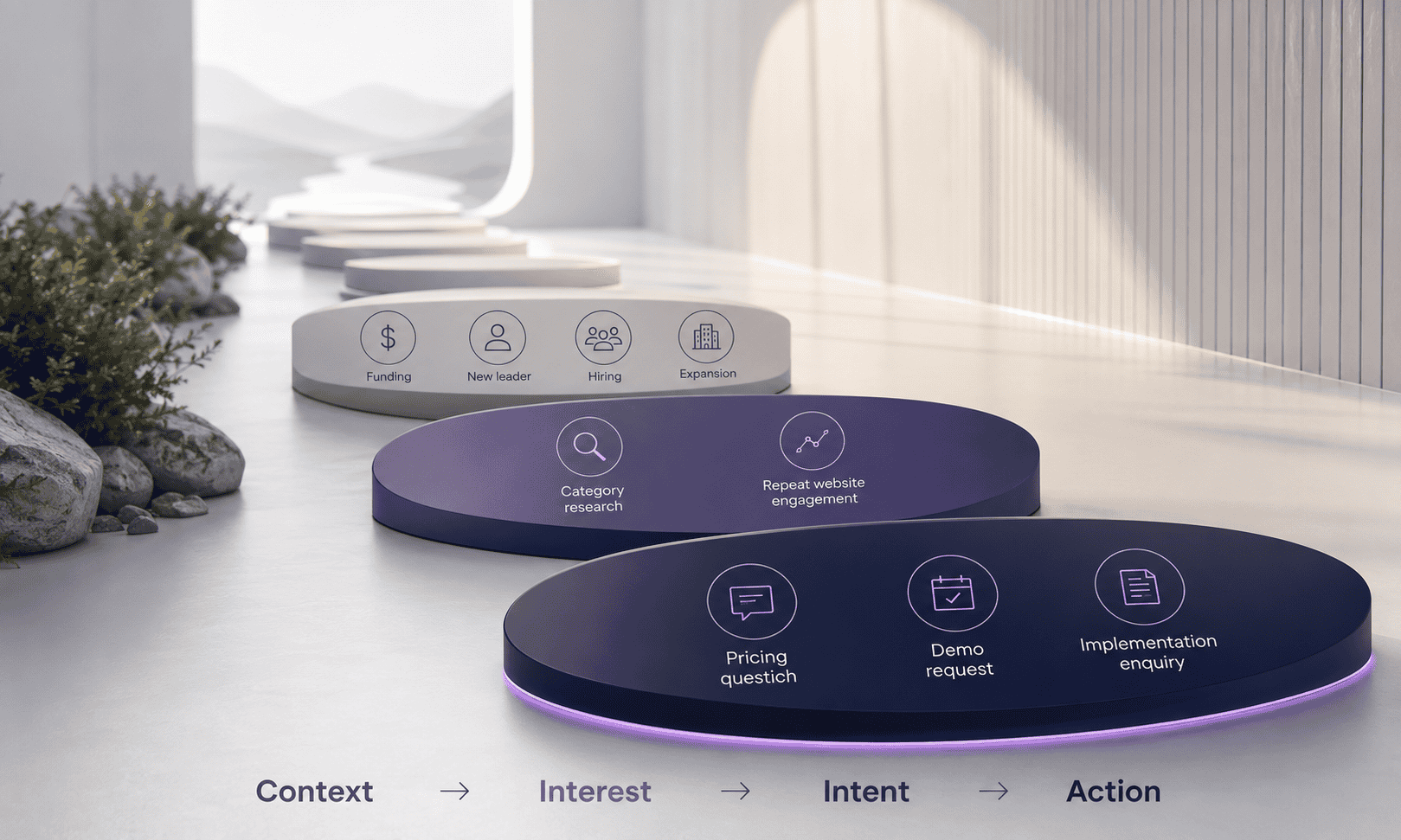
“It is a capital mistake to theorise before one has data.”
Act now: when the buyer has entered the commercial conversation#
The clearest buying intent signals usually sit close to the problem or purchasing process.
A qualified prospect requests a demo. They ask about pricing. They return repeatedly to decision-stage content and then make contact. They reply to an earlier conversation with a specific problem. They ask how implementation would work for their team.
At this point, clever prospecting can become a distraction.
If someone asks about implementation, answer the implementation question. If they request a demo, make the next step easy. If they tell you what is stopping them, address what is stopping them.
Strong intent often needs less theatre.
The buyer has already supplied the reason for the conversation.
Look closer: where most B2B buying signals actually live#
This is the more interesting territory for outbound.
A new sales leader. Relevant hiring. Funding. Market expansion. A product launch. Technology changes. A major strategic announcement.
Something has moved inside the company, but you do not yet know what that movement means for the problem you solve.
Take hiring.
A B2B SaaS company opens four SDR vacancies. If you sell into outbound sales teams, that is worth noticing because sales capacity may be changing.
But compare these two interpretations:
“You're growing the SDR team, so maintaining outbound quality must be getting difficult.”
and:
“Saw the SDR hiring alongside the expansion. Has that changed how you're thinking about keeping research and messaging consistent as more people enter the outbound motion?”
The first tells the buyer they have a problem.
The second uses the same evidence to ask a commercially sensible question.
That difference is the whole game.
The best use of a signal is sometimes invisible#
Imagine becoming VP Sales on Monday.
By Wednesday, your inbox contains fifteen versions of:
"Congratulations on the new role. New sales leaders often review their tech stack..."
Every sender believes they have been timely.
To you, they all look like they bought the same trigger data.
This is an important part of signal-based sales that gets missed: you do not have to tell the buyer every piece of intelligence you used.
A leadership change can affect who you prioritise without becoming your opening line. Hiring can shape the problem you investigate without forcing you to say “I saw you're hiring”. Intent data can help determine when an account deserves attention without making the prospect feel as though you have been watching them through the window.
Good research can remain backstage.
The buyer only needs to experience the result: a conversation that makes sense now.

Intent data gets awkward when sellers reveal too much#
B2B intent data can make hidden activity more visible.
First-party behaviour might show that an account is engaging with particular parts of your own website, content or campaigns. Third-party intent data can help identify increased research activity around relevant topics at account level.
That can be valuable for prioritisation.
It does not automatically tell you which person was researching, why they were researching, whether a project exists or whether a buying process has begun.
This is where an otherwise good signal can create terrible outreach:
“Hi Sarah, I noticed your company has been researching outbound automation…”
Even when technically possible, saying everything you know is not always commercially intelligent.
Use invisible data to make better decisions, not creepier messages.
Try the assumption test before you contact anyone#
There is a simple way to pressure-test a B2B buying signal.
Write down what you actually observed. Then write the conclusion your salesperson wants to act on. Count how many assumptions sit between the two.
For example:
Observed: The company is hiring five SDRs.
Theory: They need a new outbound sales platform.
To make that leap, you may be assuming that the roles represent growth, that outbound activity will increase, that the current process cannot support that increase, that leadership sees it as a problem, that technology is part of the answer and that the company is willing to change.
That is a lot of hidden reasoning sitting behind one little “hot account” badge.
Now compare it with:
Observed: The prospect has requested a demo and asked whether the platform supports their current email and LinkedIn workflow.
The commercial distance is much shorter.
This is why one useful signal can be worth more than six weak ones.
Signal stacking only works when the story stacks too#
Several signals can increase confidence, but only when they point towards the same underlying change.
Imagine a SaaS company has:
- appointed a new Sales Director;
- opened four SDR vacancies;
- announced entry into another market.
Individually, each deserves investigation. Together, they suggest the commercial organisation may be changing.
That is useful context.
Now imagine the signals are a funding announcement, a marketing manager liking a LinkedIn post, an engineering vacancy and somebody attending a webinar nine months ago.
Four signals.
Almost no coherent story.
This is the weakness of reducing buying signals to arithmetic. Four alerts do not necessarily create four times the intent.
Buying signals have a shelf life#
A signal can be true and still be too old to explain why you are reaching out now.
A CRO who joined eight months ago is no longer particularly new. A hiring campaign may have finished. A funding announcement from last year might already have been translated into whatever initiatives the money was intended to support.
The better question is not simply “How old is the signal?”
Ask:
Is the change created by this event still happening?
Market expansion might remain commercially relevant for months. A closed job vacancy might stop mattering quickly. An upcoming deadline could actually become more important with time.
Freshness is about the life of the business change, not just the date beside the data.
Sometimes the signal should make you wait#
Sales systems are naturally designed to discover reasons to contact people.
That creates a blind spot.
What if the signal makes the account less attractive right now?
A target company freezes hiring. A major strategic initiative is cancelled. The executive who owned the relevant area leaves. The organisation announces restructuring that clearly shifts attention elsewhere.
Those are signals too.
A useful buying-signal strategy should be capable of saying not now.
Otherwise every new piece of data eventually gets interpreted as another reason to send an email.
A B2B buying signal should change one of three things#
Before a signal reaches an SDR, ask whether it changes something meaningful.
It should change priority because this account deserves attention ahead of an equally good-fit account.
It should change timing because something has made the conversation more relevant now.
Or it should change the conversation because the new context materially affects the problem, hypothesis or question the salesperson should explore.
If it changes none of those things, you may have found interesting data.
You have not necessarily found a useful buying signal.
That distinction matters for sales leaders with a familiar problem: plenty of accounts, plenty of data, plenty of alerts — and SDRs still asking, “Who should I actually contact today?”
The answer should not be another dashboard.
It should be better commercial reasoning.
Where OREE fits#
OREE is an AI-assisted outbound sales platform designed around the work between identifying a prospect and starting a useful sales conversation.
OREE can research prospects and companies, structure available context and use selected signals to support prioritisation and outreach preparation. Hiring signals are Live, while broader buying-signal identification and funding signals are Partly live. Lead scoring for ICP-confirmed prospects and recommended contact timing are Live and should be treated as prioritisation guidance rather than confirmed purchase intent.
That boundary matters because OREE is not designed to turn a signal into an automatic declaration that somebody wants to buy.
It is designed to help answer the more useful questions:
Why this prospect? Why now? What do we actually know? What is worth saying?
The available context can then inform LinkedIn and email outreach inside a human-controlled workflow, with the salesperson retaining responsibility for what represents the business.
AI prepares. People decide and sell.
Frequently asked questions about B2B buying signals#
What are B2B buying signals?#
B2B buying signals are observable behaviours, events or business changes that may make an account more relevant for a sales conversation or indicate movement towards a commercial decision.
They range from direct behaviours such as enquiries and relevant replies to contextual events such as hiring, leadership changes, funding and expansion.
What are the strongest B2B buying signals?#
Signals closest to a real commercial action generally require fewer assumptions. Direct enquiries, relevant replies, product or implementation questions and meaningful decision-stage engagement can therefore warrant faster action than contextual company events.
The strength of any signal still depends on account fit, freshness and relevance to the problem you solve.
Is funding a buying signal?#
Funding can be useful context because investment may accompany changing priorities, resources or growth plans. The announcement itself does not prove a company needs your solution.
The more valuable research is usually what the company plans to do next.
Are job changes and hiring buying signals?#
They can be. Relevant hiring or leadership changes may indicate changes in ownership, capacity or priorities.
They should usually trigger investigation rather than an automatic assumption that the company is in-market.
Is buyer intent the same as a buying signal?#
No. A buying signal is something you can observe. Buyer intent is the commercial meaning you believe may sit behind that behaviour.
Good prospecting keeps those two ideas separate until the available evidence justifies bringing them closer together.
Data is useful. The story you tell yourself about it matters more.#
Holmes's warning survives surprisingly well in an era of intent platforms, enrichment tools and AI-generated outreach.
The danger is no longer that salespeople have too little data.
It is that we can collect a fact, infer a theory and generate a perfectly written email from that theory before anybody notices where the evidence ended.
The best B2B buying signals prevent that.
They tell you where attention is deserved, where more research is needed and where the timing may genuinely have changed. Then they leave the final commercial judgement where it belongs.
If your team has plenty of target accounts but still has to work out manually which ones deserve attention and why, see how OREE turns prospect intelligence and available signals into human-reviewed outbound.
Better signals. Better conversations.
Written by
Kingsley Nnamonah
Head of Product
Builds the OREE product. Spent the last decade shipping AI tooling for revenue teams. Writes about the engineering and product decisions behind the co-pilot.


